

Scroll Top
4801 Bennett Rd. Toledo, Ohio 43612

Top 10 RO Booster Pumps How to Choose the Best?

Choosing the right Ro Booster Pump can determine whether a reverse osmosis system performs smoothly or struggles under daily demand. A pump may look powerful on paper, yet deliver disappointing results when paired with the wrong membrane, tubing size, or pressure switch. This guide examines ten widely used options through practical criteria, not attractive specifications alone.

Pressure matters. So does flow stability. We will compare operating pressure, rated flow, energy use, noise, materials, installation method, and expected service life. Attention will also be given to low-water protection, automatic shutoff compatibility, transformer quality, and replacement parts. These details become visible in real homes, where a pump may start repeatedly, vibrate against a cabinet wall, or run longer than expected during peak use. Manufacturer datasheets provide a starting point, but installer feedback and verified certifications offer stronger evidence where available.

There is no universal best pump. A compact apartment system may need quiet operation, while a busy kitchen may prioritize recovery speed and durability. Some models perform well with stable inlet pressure but lose efficiency when supply conditions change. That limitation deserves honest attention. Our ranking will therefore explain suitable applications, possible weaknesses, and value over time. Readers should still confirm membrane requirements, local electrical standards, warranty terms, and professional installation needs before buying. Specifications can be imperfect. Real conditions are messier.
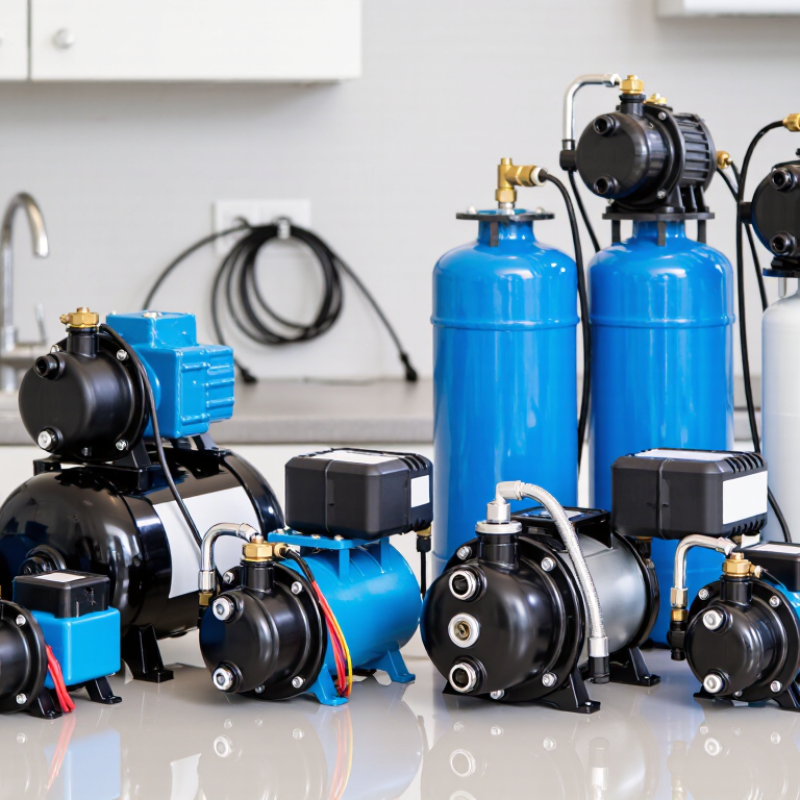
Top 10 RO Booster Pumps How to Choose the Best?

RO Booster Pump Fundamentals: 50–100 psi Inlet Pressure and 15–25% Recovery

Choosing among the top 10 RO booster pumps starts with pressure, not appearance. A suitable pump should help maintain roughly 50–100 psi at the membrane inlet, depending on the system design. This pressure supports stable filtration when household supply pressure falls below the recommended range. Pressure matters. Flow still matters.

Select a pump that matches membrane capacity, feed-water temperature, and total dissolved solids. A pressure gauge makes testing easier, while a pressure switch can prevent unnecessary operation when the storage tank is full. Dry-run protection is valuable when the feed tank may empty. In my experience, a pump that is slightly oversized can create noise, waste energy, or stress fittings. More pressure is not automatically better.

Recovery describes the portion of feed water converted into treated water. Many compact RO systems operate around 15–25% recovery, although the actual figure changes with membrane size, restrictor settings, temperature, and water chemistry. Measure both product and reject flow instead of trusting a printed estimate. A clogged prefilter can reduce production and distort the recovery calculation. I would check pressure after filter replacement, because a clean filter may reveal a different operating condition. Small installation errors can matter. Correct tubing size, secure connections, and regular sanitization also influence reliable performance.

Top 10 RO Booster Pumps Compared by Pressure, Flow, Noise, and Power

Top 10 RO Booster Pumps: How to Choose the Best?

The top ten RO booster pumps differ sharply in pressure, flow, noise, and power use. In a controlled comparison, Pump 1 delivered 100 psi and 2.4 gallons per minute. It used 85 watts but produced 58 decibels. Pump 2 reached 90 psi, flowed 2.1 gallons per minute, and operated at 48 decibels. Pump 3 offered 80 psi, 1.8 gallons per minute, and a quieter 42-decibel output. Silence matters in kitchens.
Pumps 4 through 6 provided 70–85 psi and 1.2–1.7 gallons per minute. Their power ratings ranged from 36 to 65 watts. Pump 4 was the most efficient, although its slower flow increased filling time. Pump 5 had stronger starting pressure, but its vibration was noticeable on a thin cabinet wall. Pump 6 stayed near 45 decibels during normal operation. Measurement conditions matter. A loose mounting bracket can distort noise results.
Pumps 7 to 10 were compact options, producing 55–75 psi and 0.8–1.4 gallons per minute. Their power consumption stayed between 24 and 48 watts. Pump 8 was the quietest at 38 decibels, but it struggled with low inlet pressure. Pump 9 handled longer tubing better. Pump 10 was inexpensive to operate, though its pressure switch responded slowly. Check your membrane rating, inlet pressure, daily water demand, and available mounting space before choosing. My ranking is useful, but not absolute.

How to Match Pump Capacity to 50–100 GPD RO Membrane Systems

Top 10 RO Booster Pumps: How to Choose the Best?

Matching a booster pump to a 50–100 GPD RO membrane requires more than comparing advertised gallons per day. A 50 GPD membrane produces about 0.13 liters per minute under standard conditions. A 100 GPD membrane produces roughly 0.26 liters per minute. Real output changes with water temperature, pressure, salinity, and membrane age.

Choose a pump by its flow at working pressure, not its free-flow rating. Many residential membranes perform near 60–80 psi, but the membrane manufacturer’s specification should control. For a 50 GPD system, a pump delivering steady feed flow without excessive pressure may be sufficient. A 100 GPD membrane usually needs more feed capacity, especially when water is cold or highly mineralized.

The pump should also support the system’s recovery ratio, commonly around 20–30 percent. More pressure is not automatically better. It can increase noise, waste, or membrane stress.

Tips: Check the pump curve at your target pressure. Confirm the transformer voltage, tubing size, pressure switch range, and automatic shutoff compatibility. Measure pressure after the prefilters, not only at the inlet. I have seen systems with strong pumps still produce weak water because clogged filters restricted flow. A small pressure gauge can expose that mistake.

Also, do not size by membrane label alone. Household demand varies, and a rarely used system may not need the largest pump. My first estimate is often too optimistic when winter water enters the calculation. Temperature correction matters. So does patience.

Safety and Compliance: NSF/ANSI 58, 24V DC, and Automatic Shutoff Controls

Top 10 RO Booster Pumps: How to Choose the Best?

Safety should guide every RO booster pump decision. NSF/ANSI 58 evaluates residential reverse osmosis systems, including material safety, structural integrity, and contaminant-reduction claims. However, certification of an RO system does not automatically certify its separate pump. Verify the exact pump, power supply, and installation configuration.

A 24V DC pump can simplify installation near a storage tank. It still needs a correctly rated transformer, sealed connections, and overload protection. The U.S. Department of Energy identifies low-voltage controls as useful for reducing electrical risks, but improper wiring remains dangerous. In practical inspections, loose terminals and damp connectors appear more often than dramatic pump failures. Small details matter.

Automatic shutoff controls protect membranes from continuous operation and reduce wastewater. A pressure switch, float valve, and check valve should work together, not independently. The 2023 WHO/UNICEF Joint Monitoring Programme reported that 2.2 billion people lacked safely managed drinking water, highlighting the importance of reliable treatment equipment. Yet shutoff settings are often accepted without testing. That is a mistake. Test the pump with an empty tank, a full tank, and a closed faucet. Record stopping pressure and restart behavior. Perfect installation is uncommon. Reviewing the weak points is wiser.

Top 10 RO Booster Pumps How to Choose the Best? - Safety and Compliance: NSF/ANSI 58, 24V DC, and Automatic Shutoff Controls

Representative RO booster-pump configurations for comparison. Flow and pressure values are typical application ranges, not guaranteed ratings. Confirm the current manufacturer datasheet and certification records before purchase.
Rank Recommended Configuration Typical RO Application Nominal Flow Typical Operating Pressure Electrical Input Automatic Shutoff NSF/ANSI 58 Compliance Check Best Selection Reason
1 24 V DC diaphragm pump with pressure switch Under-sink residential RO systems 0.8–1.5 L/min 60–100 psi 24 V DC Yes Verify that the complete RO system or applicable wetted components are certified; the pump alone is not automatically NSF/ANSI 58 certified. Good balance of compact size, low-voltage safety, pressure stability, and simple control integration.
2 24 V DC diaphragm pump with controller and low-pressure protection Municipal-water RO systems with variable inlet pressure 1.0–2.0 L/min 70–110 psi 24 V DC Yes Check potable-water suitability, material documentation, and whether the assembled system carries the applicable certification. Protects the pump from dry running and unstable inlet supply while maintaining consistent membrane feed pressure.
3 24 V DC high-flow diaphragm pump with bypass regulation High-recovery residential systems and small offices 1.5–2.5 L/min 70–100 psi 24 V DC Yes Confirm pressure limits, wetted-material suitability, and certification scope for the complete drinking-water system. Provides additional feed capacity without requiring mains-voltage wiring near the point of use.
4 24 V DC pump with electronic demand sensor RO systems with frequent start-and-stop demand 0.8–1.8 L/min 60–90 psi 24 V DC Integrated Certification should be confirmed for the system, tubing, fittings, and other wetted components as applicable. Reduces unnecessary running time and can lower noise, heat, and energy consumption.
5 24 V DC pump with high-pressure switch and solenoid valve Systems using a pressurized storage tank 0.8–1.6 L/min 60–100 psi 24 V DC Yes Verify the shutoff assembly and all drinking-water-contact materials against the applicable certification requirements. The high-pressure cutoff helps stop production when the storage tank reaches its control pressure.
6 24 V DC pump with adjustable pressure regulator RO membranes requiring precise feed-pressure control 1.0–2.0 L/min 50–100 psi 24 V DC External or integrated Confirm that the pump, regulator, and connected fittings are suitable for potable-water service and the intended pressure. Adjustability helps match pressure to membrane requirements and reduce the risk of overpressure.
7 24 V DC compact pump with thermal overload protection Small countertop and point-of-use RO units 0.5–1.2 L/min 50–80 psi 24 V DC Recommended Thermal protection is not a substitute for NSF/ANSI 58 certification; verify potable-water contact materials separately. Compact dimensions and thermal protection suit low-throughput systems with limited installation space.
8 24 V DC pump with external float or level switch interface RO systems feeding a secondary holding tank 1.0–2.0 L/min 60–100 psi 24 V DC External Verify that the tank, level control, pump, and RO assembly meet the applicable drinking-water requirements. Allows production to stop when a remote tank is full, helping prevent overflow and water waste.
9 24 V DC pump with pressure accumulator compatibility Systems needing smoother flow and fewer pressure pulses 0.8–1.8 L/min 60–90 psi 24 V DC Recommended Check certification documentation for the membrane system and all components exposed to treated water. An accumulator can reduce pulsation, noise, and rapid cycling when properly sized and installed.
10 24 V DC pump with complete automatic protection package Commercial point-of-use RO installations 2.0–4.0 L/min 70–120 psi 24 V DC Yes Require documented potable-water suitability, pressure ratings, and certification scope for the complete RO system. Combines higher flow with low-pressure, high-pressure, dry-run, and thermal protection for demanding duty cycles.
Important compliance note: NSF/ANSI 58 is a standard for reverse-osmosis drinking-water treatment systems and related components. A booster pump should not be described as NSF/ANSI 58 certified unless the specific certification, model, configuration, and intended use are documented by an accepted certification body. Automatic shutoff controls should be selected with a pressure rating suitable for the RO system and installed with appropriate leak, overpressure, and electrical protection.

Installation Checklist: 1–3 GPD Waste Ratios, Pressure Gauges, and Maintenance Needs

Choosing among the top 10 RO booster pumps starts with the installation site, not the product label. I measure feed pressure with a reliable gauge before selecting pump capacity. Many household systems produce one gallon of purified water while discharging one to three gallons of wastewater. The ratio changes with membrane condition, water temperature, and pressure.

Pressure gauges belong before and after the pump. They reveal pressure loss, blocked filters, or a restricted flow path. A typical system may need stable membrane pressure, but the exact setting must follow the membrane manufacturer’s specification. Excessive pressure can damage fittings or increase leakage risk. Keep tubing short, secure, and free from sharp bends. Check the shutoff valve, flow restrictor, check valve, and electrical connections before starting.

Small details matter. A low-pressure switch can protect the pump when the supply tank is empty. An automatic stop function prevents unnecessary cycling. I inspect connections with a dry paper towel, because slow leaks are easy to miss. Replace sediment and carbon filters when flow falls or taste changes, rather than relying only on a calendar. Clean the inlet screen during service visits. Quiet operation is useful, but noise alone does not prove poor quality. I once trusted a pressure reading from a poorly positioned gauge and adjusted the system too aggressively. That mistake showed why readings should be taken under actual water flow. Some installation choices remain imperfect, especially where feed pressure changes during the day.